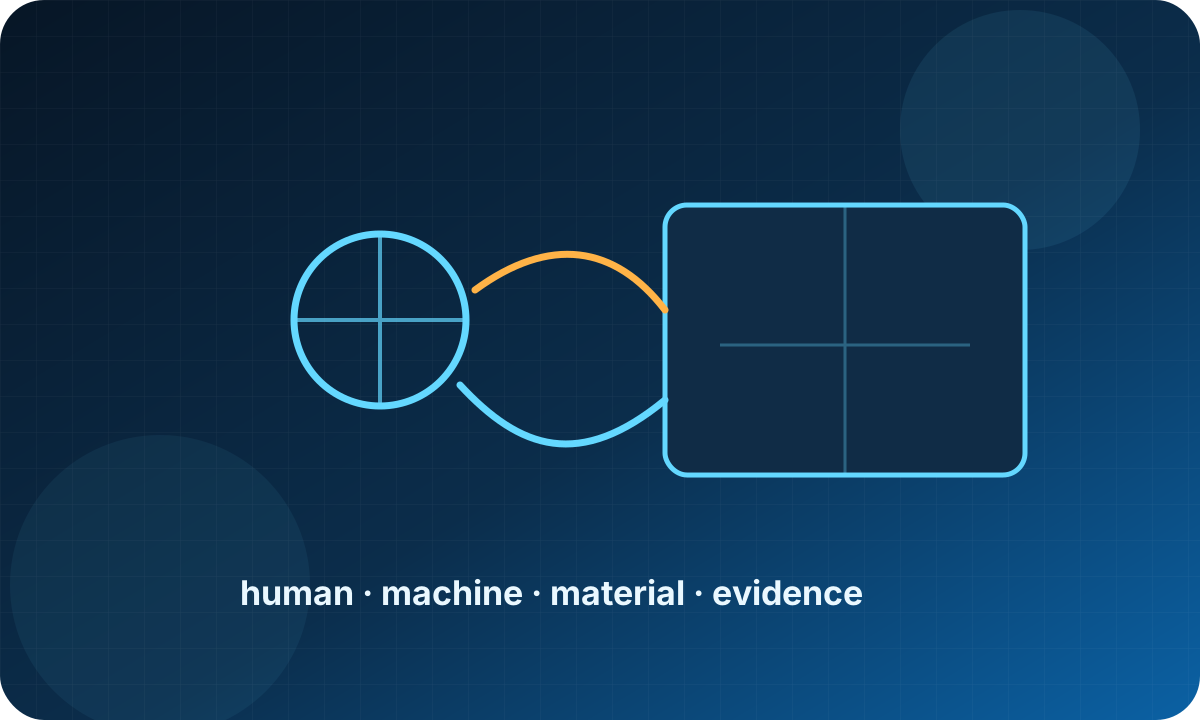
Yes, and in critical infrastructure it usually is. Operators, the facility, the operating environment and the feedback between them form a Human-System Unit, and the building's design shapes what the people inside can perceive, decide and do.
Anthromekagogy, the research framework developed by Richard Kristof, studies human-system co-evolution: the way people and the systems they build reshape each other over time. Its basic unit of analysis is the Human-System Unit (HSU), made up of a human agent, a constructed system, a task environment and a two-way feedback channel between them. The framework's examples run from a driver with a navigation app to a physician with a diagnostic model. This article applies the same unit to a building.
The facility as a constructed system
In a critical facility, each part of the HSU is concrete:
- The human agent is the operator, technician, guard or incident commander.
- The constructed system is the facility itself: its envelope and rooms, power and cooling, access control, building automation, and the models and software that interpret its sensors.
- The task environment is the operating condition, from a normal shift to a storm, an outage or an intrusion.
- The feedback channel is everything that passes between them: alarms, displays, logs, automatic actions and the operator's commands back.
Seen this way, a wall is not only a boundary. It sets how much time the human has, which determines whether the feedback channel carries a decision or only a report of a decision already made by the event.
Co-evolution happens whether anyone designs it
The framework's central claim is that adaptation runs both ways. People adapt to what a system makes easy, the system adapts to how people use it, and institutions adapt to both. Facilities show every part of that. Operators who rarely run equipment by hand lose the skill. Automation is tuned to normal operations and then surprises people in abnormal ones. Procedures drift toward what the building management system displays, not what the process needs.
None of this is a failure of any one person. It is how Human-System Units evolve when nobody measures whether the people inside them are getting more capable or more dependent.
Growth has to be reciprocal
Anthromekagogy's goal is durable capability: systems that leave people more able to act, including without the system. For a facility, that means asking two questions of every new layer of sensing or automation. Does it make the operator better at understanding and running the plant? And can the plant still be run, safely, if the new layer fails? A building that grows more instrumented while its envelope stays weak becomes noisy. A system that grows more capable while its operators grow less capable becomes brittle.
Treat the facility and its people as one unit and measure both. The practical tests are in Can Machines Guide Operators Without Replacing Their Judgment? and How Does the Co-Evolution Stack Apply to a Facility?; the framework itself is summarized on the Anthromekagogy page.
Sources
- Clark, A. and Chalmers, D. (1998). The Extended Mind. Analysis 58(1).
- Wiener, N. (1948). Cybernetics: Or Control and Communication in the Animal and the Machine. Technology Press / John Wiley & Sons.
- Kristof, R. (2026). Anthromekagogy: A Research Framework for Human-System Co-Evolution. Working paper.
Cite this article: Authentic Intelligence Research, “Can a Building Be Part of a Human-System Unit?” Authentic Intelligence, September 30, 2026, https://authenticint.com/articles/anthromekagogy-and-the-intelligent-built-environment.html.