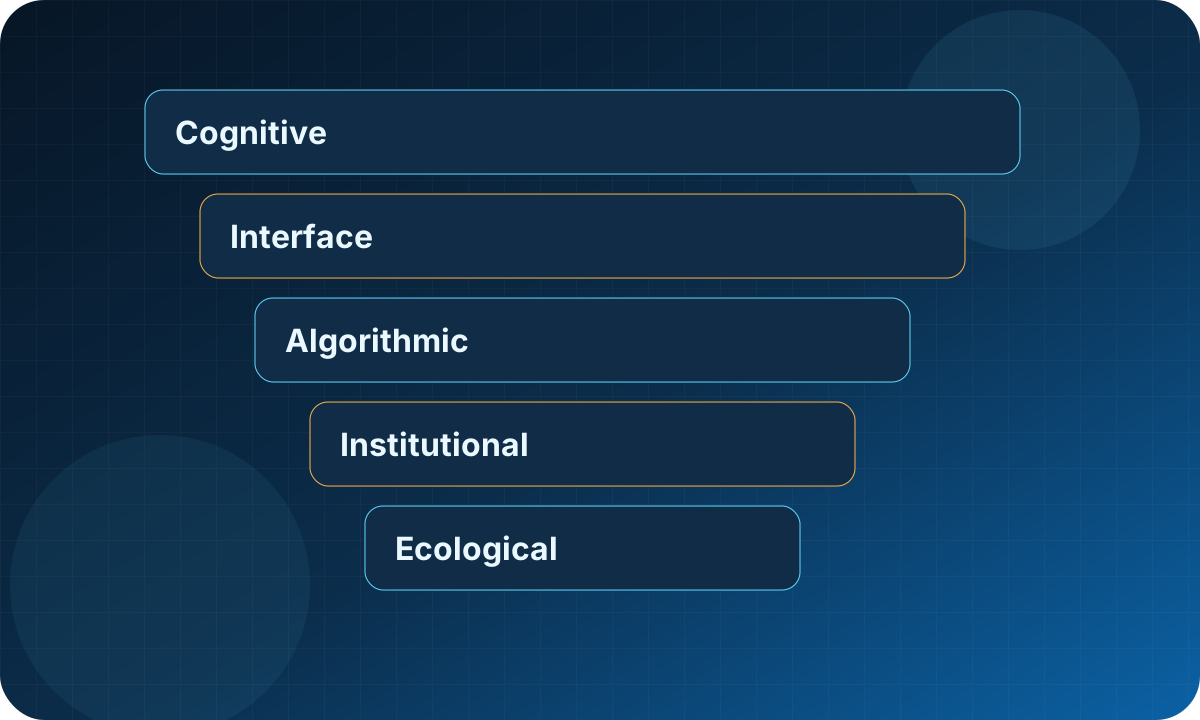
Layer by layer, from the operator's attention to the regulations and economics around the site. Problems at lower layers travel upward, and incentives at higher layers reshape what happens below.
Anthromekagogy describes human-system co-evolution as a stack of five interacting layers: cognitive, interface, algorithmic, institutional and ecological. Its vertical propagation principle holds that distortions at lower layers travel upward, and incentives at higher layers reshape optimization below. Applied to a critical facility, the stack becomes a checklist for where to look.
The five layers in a facility
Cognitive. The operator's attention, memory, reasoning and awareness of their own uncertainty. In a facility, this is whether people on shift understand the plant well enough to notice when the displays are wrong.
Interface. The friction, transparency and feedback delay between people and systems. Here the building itself is part of the interface: control room layout, alarm design, sightlines, and the physical time an envelope buys before an event outruns the people responding.
Algorithmic. What automated systems optimize, what data they learned from, and how they are updated. That includes AI models, but also relay settings, transfer logic and building automation sequences, which are algorithms with very short reaction times.
Institutional. Governance, incentives and regulation. Codes, reliability standards, insurance terms, procurement rules and the owner's own policies all live here.
Ecological. Economic constraints, cultural norms and physical limits: energy supply, climate, materials, labor and the community around the site.
How problems move between layers
A facility shows the propagation principle clearly. An interface problem, such as an alarm system that floods operators during an event, degrades the cognitive layer by teaching people to ignore alerts. An institutional incentive, such as a contract that pays for uptime percentage but not for tested manual recovery, reshapes the algorithmic layer toward automation that looks good on the metric and fails badly off it. That second pattern is what the framework calls metric corruption, optimizing a proxy in place of the goal, the effect usually summarized as Goodhart's law.
Failure modes to look for
- Automation drift at the algorithmic layer: decisions migrating to automatic systems because each step was more efficient.
- Skill atrophy at the cognitive layer: operators who no longer practice manual recovery.
- Metric corruption at the institutional layer: code compliance or uptime figures standing in for the ability to keep operating under stress.
- Power concentration at the ecological layer: dependence on a single supplier, platform or utility path that the owner does not control.
Where the building fits
The physical facility runs through every layer. It shapes attention at the cognitive layer, it is the interface at the interface layer, it hosts and constrains the algorithms, it is what institutions regulate and insure, and it consumes and depends on ecological resources. That is why hardened rooms, trusted access, tested materials and sound records belong in the same analysis as AI models and operator training. Weakness in the envelope does not stay in the envelope.
Use the stack to ask one question per layer: what needs protecting, who needs to be trusted, what is being measured, and what must still work if the layer above or below it fails.
Sources
- Kristof, R. (2026). Anthromekagogy: A Research Framework for Human-System Co-Evolution. Working paper.
- Arthur, W. B. (1989). Competing Technologies, Increasing Returns, and Lock-In by Historical Events. Economic Journal 99(394).
- Strathern, M. (1997). Improving ratings: audit in the British University system. European Review 5(3).
Cite this article: Authentic Intelligence Research, “How Does the Co-Evolution Stack Apply to a Facility?” Authentic Intelligence, September 30, 2026, https://authenticint.com/articles/the-anthromekagogy-stack-for-secure-infrastructure.html.